MakeVictoriaBetter

Monday, May 24, 2010

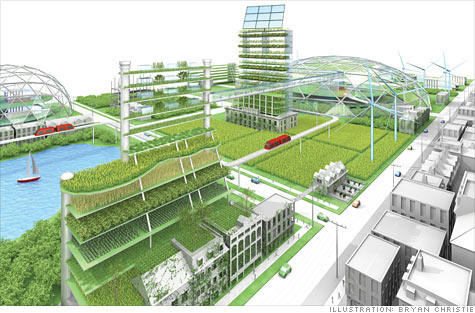
Manhattan School gets its own rooftop farm

Keeping the theme of the day going:

Archpaper.com
"Construction is due to commence this fall, and by next spring, school children should be planting vegetables on a 3,000-square-foot roof deck with spectacular views of the surrounding neighborhood. This experiment in urban agriculture... will be integrated into existing school courses on science and nutrition. The children will also have the opportunity to eat the food grown on the roof in their school cafeteria."

Read more here.

Rabbits: Eat 'em!

In light of my previous post and resulting comments, I wanted to share an older article I enjoyed.

good.is

No, this isn't about UVic. However, rabbits are close to the ideal for meat for human consumption.
And as it turns out, rabbit is one of the healthiest, leanest, and most environmentally friendly meats you can eat.

“The biggest reason that rabbits are a sustainable meat choice is that they eat forage, which is not useful for humans. This means that rabbits don’t compete with us for food calories."

Rabbits are small and can easily be raised and butchered by the DIY homesteader. They are easy to fit in a small backyard, and are happy to help you compost your leftover food.

“You can feed a rabbit on your kitchen scraps,” says Wizansky, and then use their waste as fertilizer.

Rabbits have a much smaller carbon footprint than other animals because they convert calories into pounds more efficiently. According to Slow Food USA, “Rabbit can produce six pounds of meat on the same amount of feed and water it takes a cow to produce just one pound.”
Read more at good.is

What about the rabbits at UVic? Well, that's a hot topic that may be talked about later. First, I would to know about fertilizers used on the grass on campus. Then, I will talk about ideas.


When are you going to start your rabbit farm?

Food not lawns: Urban Farms big and small.

Growing up, I used my back and front lawn more than -- I'd wager -- 99% of the population. Yet, I still used the street(s), the schoolyard, and local parks way more.

In my opinion, we don't need lawns. Most lawns are of the ornamental, look-don't-touch variety, and all of them waste water and usable land. Considering the various problems with our existing food systems, I am a strong support of urban agriculture that grows clean, healthy food within a few feet or even KMs from its final destination. I would ultimately hope that this could become a dominant function of our suburban yards.

Fortunately, we live in a country that is generally very open towards urban agriculture. See my other urban farming post, here.

Anyways, this post is just to share a few stories of interest:

Mary Ann Bodenberg of Victoria (theglobeandmail.com)

Victoria's Mary Ann Bodenberg is one urban gardener profiled in this mostly useless article from the Globe and Mail.

1. Article: Meet four budding gardeners from across the country.

More so, we live in the garden city which lives up to its name. There's a growing trend -- in Fernwood in particular -- to grow food on the boulevard, as well as in the yard. This is permitted in Victoria as long as it does not interfere with sidewalk use.

2. Article:  Community Gardens: The movement is growing.

greenkeepers.ca
Pretty cool stuff.

Yet, NIMBYism is always a problem:


3. Article: In Vancouver, one neighbour's garden is another neighbour's blight.


At least, they do not live in Orange County, where a couple is being sued by the City for digging up their lawn in order to save water and plant a garden. Wow.

4. Article: here.

"It's just funny that we pay our taxes to the city and the city is now prosecuting us with our own money," Quan Ha said. "Doesn't it waste funds to go back and forth in court, rather than sending pictures, e-mails and having phone conversations?"
[T]he couple said they had reduced their water usage from 299,221 gallons in 2007 to 58,348 gallons in 2009 [as well as $215/month on watering and a gardener].
Meanwhile, people in London and NYC are cramming gardens onto balconies, rooftops, and any other surface they can find. In the UK, 200,000 public garden plots exist for a demand of 6 Million.

urban farm design in NYC. (ft.com)

5. Article: Highly productive [in small spaces]

And, finally, we end with Detroit -- formerly, the Motor City. Detroit has been nearly annihilated by the 'recession' and the collapse of the American auto industry.

Apparently, Detroit now has a population of 700,000 in a city built for three-times that population.

6. Article: Detroit is looking to save itself with urban farming.


money.cnn.com

Yes, one of the wealthiest men left in Detroit, John Hantz, is looking to spend $30M on a urban farming project in Detroit: HantzFarm, which is set to be the world's largest urban farm even in its initial pilot project form.

.A large-scale, for-profit agricultural enterprise, wholly contained within the city limits of Detroit. Hantz thinks farming could do his city a lot of good: restore big chunks of tax-delinquent, resource-draining urban blight to pastoral productivity; provide decent jobs with benefits; supply local markets and restaurants with fresh produce; attract tourists from all over the world... Hantz is willing to commit $30 million to the project. He'll start with a pilot program this spring involving up to 50 acres on Detroit's east side. "Out of the gates," he says, "it'll be the largest urban farm in the world."

 Your thoughts?

Sunday, May 23, 2010

Speaking of Mexico: Bye, bye, helmet legislation.


I just got back from a short stint in Mexico (congrats to newlyweds Chris and Amy!).

In February, Mexico repealed their bicycle helmet laws. Mikael over at Copenhagenize gives us the commentary, if desired.

MVB presented its case for repealing BC's bicycle helmet legislation.

Here's a related quote via copenhagenize.com from the Metro (Vancouver) article:

Last September, Colin Clarke, a bike safety expert and former coach with the British Cycling Federation, published a detailed report entitled “Evaluating bicycle helmet use and legislation in Canada.”

According to his report, “helmet law effects in Canada appear to have resulted in the public being fined, subject to police involvement, loss of cycling health benefits and a reduction in civil liberties, as well as additional accidents and longer hospital stays for head injury.”

Canada, his research concludes, should emulate the cycling culture of the Netherlands, where helmet laws are unnecessary because of “good cycling facilities or wide on-road cycle lanes that avoid high speed and heavy vehicle traffic.”

Sadly, the sensibility that exists in Holland and even Saskatoon has yet to prevail in B.C. And that means cyclists like Kilburn will have to continue riding on the wrong side of the local law.

A Choice is a Vote: Your actions make our city better/worse.

When I started MVB, I made a list of posts topics so that I would not run out while waiting for more ideas. Turns out, I am yet to cover a fraction of that list. I guess that that's a good thing.
Post Synopsis:

- Every action/choice you make is a vote for more of that action/choice.

- Therefore, little lifestyle changes can make our cities better.

- Government should aid this process.
- Two great examples from NYC
"Be the change..."

MVB developed from both my collective interests and a desire to promote action and change at 'home'. We seem to be at the peak of a trend in which responsible and progressive individuals are committing money, ideas, and action to humanitarian work overseas.

That is great and all, but we need a greater emphasis on improving the way we live our lives at the individual level in the Western world. (And, the way we live is inseparable from where we live.)

To me, our ability to enact positive change in our lives and cities is far greater than we think, and our individual influence comes in many forms.

For example...

Not too long ago, I was involved in a debate about whether or not an individual person's action/vote can make a difference.

No, a single vote or action never has or never will make the difference, which is why my vote and individual actions don't really matter.

vs.
Yes, each vote or action does and will make a difference or even the difference, which is why my vote and individual actions do matter.

Long story short, my future-wife (and I) successfully defended our position, and we all ended up agreeing that...

1. Every choice you make is a VOTE for (more of) that particular thing.

2. Each vote and VOTER is also a voice that accelerates the difference made by encouraging others to make the same choice/action.

Therefore: Shop at local businesses = vote for more local business. Buy locally-grown produce = vote for more local food production. Cycle to work = vote for more bicycle infrastructure. Don't vote or have a say = let the yokels have their way.

Consider choice=vote in making Victoria better!

peoplepoweredmovement.org


I think that government can play an important role in this process by collaborating with the public in order to facilitate Do-It-Yourself change.

MVB has a lot of DIY and YIMBYism posts/links, but I just came across to great examples of this:

1. New York City has a MillionTreesNYC initiative in which the city will deliver a free tree to any resident/business upon request and also offer a free workshop on tree-care to each recipient.

2. New York City has a CityRacks initiative which (conditions apply) the city will install a bicycle rack -- free-of-charge -- to any business or resident upon request.

Brilliant!

I know Toronto has/had a similar tree initiative. What about Victoria?


Thursday, May 20, 2010

Piecemeal Change: An Example.

In Mexico for another few days, so expect more thoughts on these recent posts once I am back.


My previous post presented the competing forces of a) the erosion of the city by automobiles and b) the attrition of automobiles by the city.

In her book, The Death and Life of Great American Cities, Jacob's goes on to advocate piecemeal -- or evolutionary rather than revolutionary -- urban improvements. This piecemeal approach is not only supported by other seminal planning/design texts -- e.g., A Pattern Language -- but is also seen in many real-life examples used here on MVB:

- Copenhagen reducing parking by 2-3% per year since the 1960s.

- NYC street closures and trial-and-error projects.

- Many cities having street closures on particular days of the week/year before fully pedestrianizing a street.

Anyways, this video is another example of both piecemeal attrition of automobiles as well as inexpensive, trial-and-error projects.

I will use this video, again, when talking about bettering Shelbourne, next week.

Tuesday, May 18, 2010

The Erosion of Cities or The Attrition of Automobiles -- Jane Jacobs


As mentioned, I am out-of-town, so my posting will be intermittent and not as thoughtful as I'd wish. 


streetsblog.org


In previous posts, I have talked about the 'perpetual cycle' that is created when attempting to increase mobility via private automobile. Cars beget cars.

In her seminal work The Death and Life of Great American Cities, Jane Jacobs -- amateur-activist-turned-urban-guru/prophet, whom I shall talk about much more -- has a chapter entitled 'Erosion of Cities or Attrition of Automobiles':

Today, everyone who values cities is disturbed by automobiles.
Traffic arteries, along with parking lots, gas stations and drive-ins, are powerful and insistent instruments of city destruction. To accommodate them, city streets are broken down into loose sprawls, incoherent and vacuous for anyone afoot... City character is blurred until every place becomes more like every other place, all adding up to Noplace. 
 Noplace.

Keep in mind that this was published in 1961 -- that's 50 years ago.
Too much dependence on private automobiles and [emphasis added] city concentration of use are incompatible. One or the other has to give... Depending on which pressure wins most of the victories, one of the two processes occurs: erosion of cities by automobiles, or attrition of the automobiles by cities.

...
Erosion of cities by automobiles entails so familiar a series of events that these hardly need describing... Because of vehicular congestion, a street is widened here, another is straightened there, a wide avenue is converted to one-way flow, staggered-signal systems are installed for faster movement, a bridge is double-decked as [etc.]... More and more land goes into parking...

No one step in the process is, in itself, crucial. But... each step, while not crucial in itself, is crucial in the sense that it not only adds its own bit to the total change, but actually accelerates the process. Erosion of cities by automobiles is thus an example of what is known as "positive feedback." In the case of positive feedback, an action produces a reaction which in turn intensifies the condition responsible for the first action. This intensifies the need for repeating the first action, which in turn intensifies the reaction, and so on, ad infinitum. It is something like the grip of a habit-forming addiction.

 LA - famous junky.

Anyways, I just wanted to share that, as someone interested in such matters, I have come to understand this phenomenon (which is not readily available in the literature) a mere 5 decades after someone published a book telling of such things.

Today, any traffic engineer or city planner would be considered radical, innovative, and -- usually -- very unpopular should he/she suggest and act on such wisdom.

--

Related: Expanding roadways = urban laxatives