This just in, Victoria is the culture capital of Canada.
Hooray! Victoria is the best! Our work is done!
Oh, wait. In the words of The Missus:
"Best in Canada? If I live on a pile of dung, and someone says 'hey, you are on top of the pile!' I still live on a pile of dung."
Monday, May 31, 2010
Sunday, May 30, 2010
Why Canada's Culture is 'Boring'.
This could and maybe will be the subject of book; so, forgive any necessary gaps in thinking, here.
Note: This is full of generalizations that may better apply to more sprawled cities than Victoria, but still apply.
-----
A great conversation with an Iranian, today.
Why is it that Canada has efficient infrastructure, strong education and health care systems, pristine environments, relatively limited social problems, but somehow suffers from a 'lack of' or boring culture?
A very subjective sentiment, yet one often expressed by Canadians and visitors, alike.
Culture is based on the shared traditions and attitudes of social group. As such, I believe that a primary cause of this 'lack of' (debatable concept, but easiest way to express it) culture is a lack of two types of public, social interactions.
First and most obviously, we lack good cafe culture.
That is, we lack vibrant public spaces (e.g., plazas, patios, parks) full of life -- aka people.
To me, this is almost exclusively down to our auto-oriented as opposed people-oriented and human-scaled built environments. Simple as that.
(p.s., Name a vibrant public space in Victoria. Once a year doesn't count.)
Second and less obviously, we lack casual 'sidewalk' culture.
Jane Jacob's was a huge proponent of urban design that facilitated healthy sidewalk culture:

Pod world: Go from house to garage to car to parking structure to elevator to cubicle/office to elevator to parking structure to car to garage and back into the house. 'Hi, neighbour!'
In a pod world, one struggles to develop a healthy sidewalk culture. Therefore, exposing ourselves to strangers -- particularly neighbours -- threatens the possibility of those unwelcome entanglements.
Back to Jane:
Revolutionary Road Syndrome is -- oversimplified -- a symptom of (primarily) suburbanites so isolated from any opportunity for healthy casual public interaction that all social interaction has to be made 'by reservation'.
And, thus, suffers are actually 'happy' to remain in their pods and ever-convey to neighbours that they are 'fully booked', when in fact they are both just watching the same TV show.
-
I think we greatly underestimate the effect of our built environment on our behaviour and so way of life and so culture.
--

Yes, people live -- and live -- on this street, too.
Note: This is full of generalizations that may better apply to more sprawled cities than Victoria, but still apply.
-----
A great conversation with an Iranian, today.
Why is it that Canada has efficient infrastructure, strong education and health care systems, pristine environments, relatively limited social problems, but somehow suffers from a 'lack of' or boring culture?
A very subjective sentiment, yet one often expressed by Canadians and visitors, alike.
Culture is based on the shared traditions and attitudes of social group. As such, I believe that a primary cause of this 'lack of' (debatable concept, but easiest way to express it) culture is a lack of two types of public, social interactions.
First and most obviously, we lack good cafe culture.
That is, we lack vibrant public spaces (e.g., plazas, patios, parks) full of life -- aka people.
To me, this is almost exclusively down to our auto-oriented as opposed people-oriented and human-scaled built environments. Simple as that.
(p.s., Name a vibrant public space in Victoria. Once a year doesn't count.)
Second and less obviously, we lack casual 'sidewalk' culture.
Jane Jacob's was a huge proponent of urban design that facilitated healthy sidewalk culture:
[There is] an almost unconsciously enforced, well-balanced line... between the city public world and the world of privacy.
This line can be maintained, without awkwardness to anyone, because of the great plenty of opportunities for public contact in the enterprises along the sidewalks, or on the sidewalks themselves, as people move to and fro or deliberately loiter when they feel like it, and also because of... meeting places [e.g., business]... where one is free to either hang around or dash in and out, no strings attached.
Under this system, it is possible in a city street neighbourhood to know all kinds of people without unwelcome entanglements, without boredom, necessity for excuses, explanations, fears of giving offense, embarrassments respecting impositions or commitments, and all such paraphernalia of obligations which can accompany less limited relationships.Let's return to Canada. Some say that North Americans are 'obsessed' by privacy. I don't think this is the case; I think this is an inevitable behavioural reaction to our pod world.
Pod world: Go from house to garage to car to parking structure to elevator to cubicle/office to elevator to parking structure to car to garage and back into the house. 'Hi, neighbour!'
In a pod world, one struggles to develop a healthy sidewalk culture. Therefore, exposing ourselves to strangers -- particularly neighbours -- threatens the possibility of those unwelcome entanglements.
Back to Jane:
[The] more common outcome in cities, where people are faced with the choice of sharing much or nothing, is nothing. In city areas that lack a natural and casual public life, it is common for residents to isolate themselves from each other to a fantastic degree. If mere contact with your neighbors threatens to entangle you in their private lives, or entangle them in yours... the logical solution is absolutely to avoid friendliness or casual offers of help.
As a practical result, the ordinary public jobs -- like keeping children in hand -- for which people must take a little personal initiative, or those for which they must band together in limited common purposes, go undone.As a result, we are left with what The Missus and I now call Revolutionary Road Syndrome.
Revolutionary Road Syndrome is -- oversimplified -- a symptom of (primarily) suburbanites so isolated from any opportunity for healthy casual public interaction that all social interaction has to be made 'by reservation'.
And, thus, suffers are actually 'happy' to remain in their pods and ever-convey to neighbours that they are 'fully booked', when in fact they are both just watching the same TV show.
-
I think we greatly underestimate the effect of our built environment on our behaviour and so way of life and so culture.
--
Yes, people live -- and live -- on this street, too.


Making Cycling Sexy
This is actually a theme that MVB has been planning to explore (and act on). But, in place of immediate original content, here is some more sharing:
I thoroughly enjoyed this post on Copenhagenize.com. It's essentially a two-article exchange between author Mikael and a reader about promoting cycling by making it most convient vs. making it sexy and high status.

Here is an excerpt from the reader's 'article':
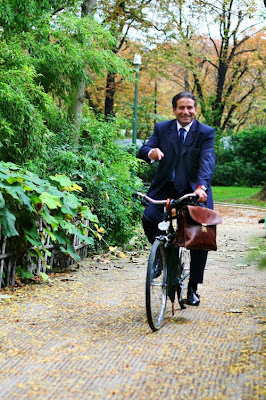
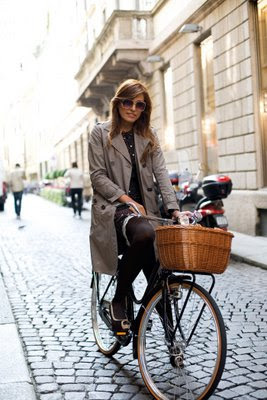
I thoroughly enjoyed this post on Copenhagenize.com. It's essentially a two-article exchange between author Mikael and a reader about promoting cycling by making it most convient vs. making it sexy and high status.

(For the record, I'm not calling Ellen Page sexy. This is just good Canadian content.) from copenhagencyclechic.com
Here is an excerpt from the reader's 'article':
Last week Mikael wrote [about] U.S. cycle advocates... who [incorrectly] seem to assume that people will take up bicycles as transportation because it’s the right and moral thing to do.
The infrastructure of Copenhagen is efficient and practical... Really, though, Copenhagenize.com is not selling asphalt and blue paint; it’s selling style.
For people in “developing bicycle cultures,” Mikael offers an alluring ideal, which often involves attractive women (and men) in tasteful clothes, undoubtedly on their way from fabulous apartments to up-to-the-minute offices or chic restaurants and bars, all of which we can imagine filled with well-designed Danish furniture. For a lot of people, this will look like the good life, or at least one version of the good life.
But here’s the problem: for a lot of people in my “developing cycling culture,” the Copenhagenize fantasy does not look like the good life. In San Francisco, New York, Portland, and a few other cities, sure, people are likely to agree. In those few places, Americans really aren’t too different from their urban European counterparts. They want the same things, more or less, and follow the same styles (again, more or less).
But the vast majority of Americans don’t find that lifestyle or its signifiers appealing. It’s not just true that most Americans live in automobile-dependent suburbs; they /like/ living in automobile-dependent suburbs. Even when cycling clearly is the fastest, most convenient way to get somewhere, they won’t do it, and they’ll look with disdain on anyone who does.
In any culture – as far as marketing is concerned – what matters is status. People will buy things if they think they’ll get approval and envy from the people around them. In mainstream U.S. culture, driving a car in a city that has been designed only for driving cars is a high-status activity. It implies that you have a lot of private property (power, wealth, respect) and that you don’t have to enter into public, shared spaces (vulnerability, poverty, disrespect).
In the worldview through which most Americans understand their lives, a car is an extension of the suburban home: independent, private, isolated. And in that worldview, isolation is a good thing. In this world, apartments are bad. Urban life as Mikael presents it is bad. Interactions with strangers are bad. We need protection from strangers, and a mobile steel-and-glass box – the bigger, the better – is the best way to get that protection.
Transportation biking, then, is a low-status activity – a /very/ low-status activity.
What, then, is to be done? I do think it’s possible to market cycling to the mainstream here in the U.S., and in developing cycling cultures around the world. But the way to make that happen is to tie cycling to high-status lifestyles in specific local cultures.Here is the entire article and Mikael's response.
I live in North Carolina... pretty deep in the conservative “red-state” area. Here in Greenville, the current model of the good life includes a big suburban-style house, a really big SUV, a significant dose of evangelical Christianity and a lot of college football. This may not appeal to readers from other parts of the world, but that’s the point: local culture does matter.
But even here, and in much of the South, I can see possibilities. For instance, I think a "Charleston" approach would appeal to quite a lot of people -- blonde sorority girls on updated beach cruisers, tailgate parties with kegs and dogs (arriving by bike trailer), couples who look like George W. and Laura Bush (or even better, Cindy McCain) pulling up on expensive city bikes to big ol' Victorian houses in dense, Spanish-moss-draped neighborhoods right out of Southern Living.
Wherever you live, though, the point is to determine who the high-status people are. They're the ones you need to reach, and they’re the ones you need to co-opt. Others will aspire to follow them. Once cycling becomes a high-status activity, people will do it even where the actual road infrastructure isn’t very friendly – just as they now refuse to do it, even where the roads are pretty good. Like every culture, bicycle culture is all in your head.

Saturday, May 29, 2010

Hamilton more progressive than Victoria?
Victoria has been humming and hawing over even a partial and temporary Gov't Street 'closure' for decades. MVB post, here.

Anyways, I just saw a poster for Open Streets Hamilton, a street 'closure' in Hamilton on two different Sundays, this year.

Anyways, I just saw a poster for Open Streets Hamilton, a street 'closure' in Hamilton on two different Sundays, this year.
Hamilton is joining a growing number of other North American cities such as New York, Portland, Winnipeg, Ottawa and Barrie to “Open Streets” for pedestrians, cyclists and shoppers to enjoy all that the street has to offer...
Well, this is embarrassing.James Street North... will be closed to automobiles, and open to a festival of people walking, cycling, rollerblading, watching demonstrations, trying a new activity, listening to music and bands, or shopping in the various shops and restaurants along the street.
Friday, May 28, 2010
The Commuter's Paradox: The effect of long commutes on happiness
I am often amazed at how much time people are willing to spend in traffic to get to and from work, everyday. It never struck me as being 'worth it' (extraordinary situations aside).

(Excerpts and material taken from Commuting by Jonah Lehrer, author of How We Decide)
David Brooks, summarizing the current state of happiness research:
Swiss economists Bruno Frey and Alois Stutzer have 'discovered' the commuter's paradox: When choosing where to live, people underestimate the trouble of long commutes, leading them to thinking that a big house in the suburbs/exurbs will make them happier, even if it means extra driving.
Yet, the time in traffic is agony and a bigger house doesn't do much for you. Frey and Stutzer calculated that a person with a one-hour commute need earn 40 percent more money to be as satisfied as the person who walks to work.
The speculative hypothesis of a psychologist at Radboud University in the Netherlands argues that long-distance commuters are victims of a "weighting mistake," a classic decision-making error in which we lose sight of the important variables:
What are your thoughts? What do you prefer? How long is your commute? Would you trade size for location?
(Excerpts and material taken from Commuting by Jonah Lehrer, author of How We Decide)
David Brooks, summarizing the current state of happiness research:
(Well, my commute is about 2 minutes by bike, and I am getting married in a few months. Perfect.)The daily activity most injurious to happiness is commuting. According to one study, being married produces a psychic gain equivalent to more than $100,000 a year.In other words, the best way to make yourself happy is to have a short commute and get married.
Swiss economists Bruno Frey and Alois Stutzer have 'discovered' the commuter's paradox: When choosing where to live, people underestimate the trouble of long commutes, leading them to thinking that a big house in the suburbs/exurbs will make them happier, even if it means extra driving.
Yet, the time in traffic is agony and a bigger house doesn't do much for you. Frey and Stutzer calculated that a person with a one-hour commute need earn 40 percent more money to be as satisfied as the person who walks to work.
The speculative hypothesis of a psychologist at Radboud University in the Netherlands argues that long-distance commuters are victims of a "weighting mistake," a classic decision-making error in which we lose sight of the important variables:
Consider two housing options: a three bedroom apartment that is located in the middle of a city, with a ten minute commute time, or a five bedroom McMansion on the urban outskirts, with a forty-five minute commute. "People will think about this trade-off for a long time," Dijksterhuis says. "And most them will eventually choose the large house. After all, a third bathroom or extra bedroom is very important for when grandma and grandpa come over for Christmas, whereas driving two hours each day is really not that bad."
Having lived in the Greater Toronto Region and LA, I regularly talk to people that travel 1.5 hours, each way, to work. That's mind-boggling to most Victorians.What's interesting, Dijksterhuis says, is that the more time people spend deliberating, the more important that extra space becomes. They'll imagine all sorts of scenarios (a big birthday party, Thanksgiving dinner, another child) that will turn the suburban house into an absolute necessity. The pain of a lengthy commute, meanwhile, will seem less and less significant, at least when compared to the allure of an extra bathroom. But, as Dijksterhuis points out, that reasoning process is exactly backwards: "The additional bathroom is a completely superfluous asset for at least 362 or 363 days each year."
What are your thoughts? What do you prefer? How long is your commute? Would you trade size for location?
Avoiding Gender-bending Plastics
The following post is just excerpts from this article at Good.is. Although this isn't exactly typical MVB material, I believe that this is a massively important issue that should be made known.

good.is
Well, before I start, I will point out that my soon-to-be-wife has been preaching about this for two decades. Takes awhile for the masses to come around.
--
[Phthalates are] a category of chemical plasticizers that has been linked to gender-bendy birth defects in baby boys. Phthalates... are everywhere... in your car, your shower curtain, your moisturizer, your hairspray, your air freshener, your makeup, your cologne, and your kids' toys.
First, let's make one thing clear: The effects of phthalate exposure have been fairly conclusively established, and that research is acknowledged by countless public-health experts and environmental-health organizations—but not by the FDA. (Naturally, the chemical and cosmetic trade organizations that sell and use these ingredients also claim phthalates are safe, but never mind them.)
... their ubiquity in beauty products is suspected to be the reason why so many baby boys are born with hypospadias (which is a birth defect where the opening of the urethra is in the wrong place) and undescended testes (which is exactly what it sounds like), and why so many girls have breasts before their 10th birthday.
There are a lot of instances where we can't control our phthalate exposure, it's true—but there are tons where we can. Here are some easy places to start:
1. Pick another shower curtain. New-shower-curtain-smell is a dead giveaway for the presence of phthalates. Phthalates are used to soften PVC, so avoid vinyl curtains altogether. Instead, try cotton or hemp, or go for polyester, which is made from petroleum (bad) but is recyclable and phthalate-free (good). Ikea has cheap PEVA ones, too. 2. Ditch your perfume or cologne. Fragrance almost always contains phthalates, which are used to make smells stick to you and last a long time. In a perfect world, in addition to perfume, you'd also avoid anything with artificial fragrance in it—including your moisturizer, shampoo, shaving cream, deodorant, and so forth. But if you don't want to go whole-hog, at least chuck your cologne. Everyone in the elevator will thank you. 3. Use DBP-free paint and nail polish. Nail polish and wall paints needs plasticizers of some kind of another to make them spread easily, but not all contain phthalates. Thankfully, lots of companies have phased out the use of DBP, a particularly gnarly phthalate, making it easier to avoid than ever. For nails, opt for O.P.I.—which phased out DBP and other nasty chemicals a couple of years ago—or an eco brand like Priti nails. For your walls, there are plenty of low-VOC options at all the big-box stores. 4. Don't use air freshener or chemically scented candles. They give people headaches, and usually smell kind of gross. If you want to make your place smell nice, make some cookies, simmer cinnamon sticks in a pot on the stove, or burn soy- or beeswax-based wax candles scented with essential oils. 5. Don't use hairspray. And if you must, get some from the health-food store or make it yourself out of vodka. When you use hairspray you are basically spraying flexible plastic onto your hair to make it stay put. It can be inhaled and absorbed through the scalp—and it almost certainly contains artificial fragrance, which makes it a phthalate trifecta. Stay away. 6. Use plastics with the recycling codes 2, 4, or 5. This is an admittedly inexact way of figuring out if plastics in reusable food containers contain these stealth chemicals, but those codes mean the plastics are less likely to contain phthalates or BPA—another hot-button chemical you probably don't want in or around you. Plastic #1, which is what most water and soda bottles are made of, as well as many shampoos, leach phthalates if you reuse them. So, don't. 7. Start reading labels on your personal-care products. Fragrance is a no-no (see above), but because of a legal loophole, the ingredients that make up that fragrance don't get listed on labels. Anything with artificial fragrance—and that means just about anything in your bathroom or makeup bag—should be avoided if you're pregnant, and, depending on how hardcore you want to get, the rest of the time, too. Sometimes phthalates are on labels, and those should be avoided as well: DBP, DMP, DEP, and BzBP are verboten. 8. Buy toys and teethers carefully. Favor wooden and cloth toys, but anyone who's ever been around a baby knows how much they love plastic. Get to know different brands, and how ethical their manufacturing and labeling practices are. And don't let your kids chew on anything that isn't specifically listed as being BPA- and phthalate-free. Speaking of which.... 9. Be wary of product claims. It would be against the law for a product to call itself phthalate-free if it isn't ("misbranding" is the fancy term), but the truth is, there are just not that many people checking these things yet. In the meantime, err on the side of caution—especially when you're talking about babies. 10. Don't drive. OK, not totally realistic for some people, but dashboards and other pliable-plastic car parts contain these chemicals. Do with that what you will. But when you go to the carwash, and they ask you what "scent" you want, say "None, thanks."


Subscribe to:
Posts (Atom)